|
Reading (pronounced like "redding", not
"reeding") is a town in Berkshire in the South East of England.
Its main attractions are the medieval abbey ruins, the rivers Thames and
Kennet, the surrounding Thames Valley countryside, a major shopping
center, restaurant and pubs.
 There are
several possible derivations of the Reading's name, however the true
source is obscured. Reading holds several Royal Charters permitting
parliament to be held there during times of plague or rebellion in
London. There are
several possible derivations of the Reading's name, however the true
source is obscured. Reading holds several Royal Charters permitting
parliament to be held there during times of plague or rebellion in
London.
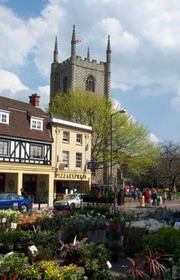 Reading grew
rich through the medieval and Tudor periods thanks to a booming trade in
cloth. The siege imposed by parliament on the town during the English
Civil War crippled the town's economy which never recovered. The economy
of the town is historically most famous for the '3Bs' of Biscuits (US
English:Cookies), Beer and Bulbs (of which only Beer has survived though
the brewery is scheduled to close by 2010) however, In recent years
Information Technology and insurance have replaced these traditional
businesses. As such it isn't an obvious travel destination in its own
right, but if you happen to be here on business there is plenty to see
and do. Reading grew
rich through the medieval and Tudor periods thanks to a booming trade in
cloth. The siege imposed by parliament on the town during the English
Civil War crippled the town's economy which never recovered. The economy
of the town is historically most famous for the '3Bs' of Biscuits (US
English:Cookies), Beer and Bulbs (of which only Beer has survived though
the brewery is scheduled to close by 2010) however, In recent years
Information Technology and insurance have replaced these traditional
businesses. As such it isn't an obvious travel destination in its own
right, but if you happen to be here on business there is plenty to see
and do.
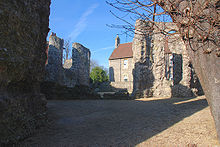
The
Forbury Gardens,
located in the center of town, have recently been restored to their
original Victorian Splendor. The adjoining ruins are the remains of a
once powerful Abbey, sacked by Henry VIII during the dissolution of the
monasteries.
Reading
is also home to the gaol in which Oscar Wilde was imprisoned for
homosexuality and where he composed his famous ballad. These days it is
mainly a remand prison for young offenders.
Reading
is at the heart of an attractive area of the Thames Valley,
sitting across the confluence of the Thames and Kennet rivers amid green
rolling hills, thatched cottages and pubs. It is surrounded by numerous
small towns and villages such as Thatcham, Pangbourne and Streatley, many
of great age and beauty. Much of it is now part of the Chilterns Area
of Outstanding Natural Beauty with the Cotswolds being easily
reachable.
 It is a long
inhabited and well domesticated area that sits at the junction of several
major transport routes, both rail and road. As such, Reading serves as a
major hub for commuter traffic into and out of London. It is a long
inhabited and well domesticated area that sits at the junction of several
major transport routes, both rail and road. As such, Reading serves as a
major hub for commuter traffic into and out of London.
Incidentally
describing Reading as a city could raise the odd eye-brow locally.
Despite its size and population it is not technically a city. To become a
city in the UK you need a royal charter. To gain a charter the town used
to have to contain a cathedral and due to Reading having such a large
abbey a cathedral was never built there, the law was changed in 1889 however
many people still believe this to be the case. Charters are now granted
periodically with Reading loosing out, most recently to Newport,
Wolverhampton and to the locals most annoyingly to their south coast
rivals Brighton and Hove. However none of this has stopped the council
pretending, with lots of new signs directing people to the “city
centre” and all buses (Reading Buses is owned and operated by
Reading Borough council and controls nearly all routes in and around Reading)
for a while displayed “City Centre” as their destination,
although this has now changed to "central Reading".
Reading
has become more famous recently as the local football team was promoted
to the Premier League, in part at least thanks to benefactor, John
Madejski, who built the Madejski Stadium located south of the town. This
has raised awareness of the town throughout the United Kingdom. The
promotion also led to a resurgence in the south of the town with new
commercial properties, new housing developments and new superstores such
as B&Q and CostCo.
The
city centre has been transformed over the past 10 years with a modern
shopping centre called The Oracle. Further developments and
new apartment blocks are being built...
|