|
Mystic
and New London Connecticut: Seafaring a Cut Above
South
Central Connecticut: Castles and Submarines
There
Are More Places To Visit In The Connecticut
Why
Vacation in Connecticut
 
Maple
Tree in Autumn, Litchfield Hills, Connecticut, USA
Buy at
AllPosters.com
South Central Connecticut: Castles and
Submarines by John Pelley
Drive
through the country side of South Central Connecticut. The country is
very rolling, with many field stone fences. In East Haddam is St
Stephen's Episcopal Church, which has a bell dating from 815 A.D. It is
said to be the world's oldest church bell still in use. The Spanish
monastery, from which it comes, was destroyed by Napoleon and the bell
was salvaged. It arrived here on a shipload of metal and found a home in
this parish church to toll again.
Also
in East Haddam is the Goodspeed Theater, in which are performed musicals.
Victorian in architecture, the theater overlooks the Connecticut River.
Also
overlooking the river is the Gillette Castle. Built between 1914 and 1919,
this building built entirely of fieldstone (six million on the property)
is an example of the post Victorian Movement, reminiscent of the Prairie
School of Chicago. William Gillette (no relation to Gillette Safety Razor
Company), once a neighbor of Mark Twain in Hartford, ignored the wishes
of his father and became an actor. During his career he wrote and stared
in over twenty plays, most notably bringing the role of Sherlock Holmes
to the stage. Around the turn of the century he was earning over $200,000
per year. He fell in love with the overlook of the river, which he called
the Seventh Sister and proceeded to build this home. Consisting of 24
rooms, the house contains many ingenious inventions thought up by
Gillette. Every door and lock is of a different design. He had a special
lock on his liquor cabinet that even Albert Einstein or Mark Twain could
not figure out how to open. He would silently laugh at them by viewing
their frustrations in strategically placed mirrors. He had a small scaled
railroad erected on his grounds with over three miles of track, including
trestles and a hundred yard tunnel. The house itself has undergone
extensive reconstruction and has now reopened to much of its former
glory. At five dollars per person it is a bargain to see the tribute of
William Gillette. Did I mention the view? Overlooking the Connecticut
River and the surrounding countryside, you can see the small ferry
crossing the River with passengers and cars.
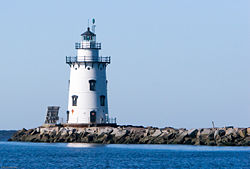 Old Saybrook is at the tip
of the Connecticut River and Long Island Sound. Once the home of Yale
University before it moved to New Haven, it is now a quiet community. In
the memorial park are the remnants of an old train roundhouse, a building
in which maintenance was performed on the engines. A boardwalk leads out
to an estuary and marsh lands with a description of the flora and fauna
found there. An interesting plaque gives the history of the Pequot Wars.
The tale told that the Pequot started the war with the British and the
British finished it off. Is there a third side to the story? Old Saybrook is at the tip
of the Connecticut River and Long Island Sound. Once the home of Yale
University before it moved to New Haven, it is now a quiet community. In
the memorial park are the remnants of an old train roundhouse, a building
in which maintenance was performed on the engines. A boardwalk leads out
to an estuary and marsh lands with a description of the flora and fauna
found there. An interesting plaque gives the history of the Pequot Wars.
The tale told that the Pequot started the war with the British and the
British finished it off. Is there a third side to the story?
Across
the river is Old Lyme, purported to be the home of many ship captains.
There is no map designating the historical homes. The locals claim that
the town residents want to live in anonymity and keep the tourists away.
On the Northern edge of town is Florence Griswold Museum with a
collection of American Impressionists. Adjacent is an art academy and
museum, which accepts tourists. Today Lyme has the dubious distinction of
being the name of Lyme disease carried by the deer tick. There goes
anonymity.
Further
East is Groton, the home of the USS Nautilus, the first nuclear
submarine, launched in 1954. She and her crew were the first ones to sail
under the North Pole. Audio guided tours are available for free aboard
the sub. She is the only nuclear submarine on display in the world.
Groton is also the home of the Coast Guard Academy.
On the
grounds is the submarine museum, with displays of submarines used since
Bushnell invented the Turtle during the revolutionary war. Hand propelled
he drove the sub into New York Harbor to blow up the English ship Eagle,
but was unable to attach the charges. The museum has many hands on
displays on life in a submarine, from the attack room, the conning tower
with periscope, torpedo room, sonar and radar. Outside are one man and
two man subs used by Italy, Japan, and other countries in war.
top
|