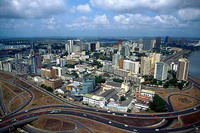
 Côte
d'Ivoire in International French; officially the République
de Côte d'Ivoire), or, translated into English, the Ivory Coast,
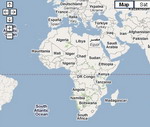
is a country in West Africa. It borders Liberia and Guinea to the west,
Mali and Burkina Faso to the north, Ghana to the east, and the Gulf of
Guinea to the south. Côte
d'Ivoire in International French; officially the République
de Côte d'Ivoire), or, translated into English, the Ivory Coast,
is a country in West Africa. It borders Liberia and Guinea to the west,
Mali and Burkina Faso to the north, Ghana to the east, and the Gulf of
Guinea to the south.
The country's early history
is virtually unknown, although a Neolithic culture is thought to have existed.
In the 19th century it was invaded by two Akan groups. In 1843-1844, a
treaty made it a protectorate of France and in 1893 Côte d'Ivoire
became a French colony.
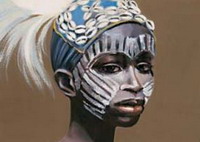 The
country became independent in 1960. Until 1993 it was led by Félix
Houphouët-Boigny and was closely associated economically and politically
with its West African neighbors, for example forming the Council of the
Entente. At the same time the country maintained close ties to the West,
which helped its economic development and political stability. The
country became independent in 1960. Until 1993 it was led by Félix
Houphouët-Boigny and was closely associated economically and politically
with its West African neighbors, for example forming the Council of the
Entente. At the same time the country maintained close ties to the West,
which helped its economic development and political stability.
Since the end of Houphoët-Boigny's
rule, this stability has been destroyed by two coups (1999 and 2001) and
a civil war since 2002, which has hampered its economic development.
Côte d'Ivoire is a republic with a strong executive power personified
in the President. Its de jure capital is Yamoussoukro and the official
language is French. The country is divided into 19 regions and 58 departments.
Côte d'Ivoire's economy is largely market-based and relies heavily
on agriculture, with smallholder cash crop production being dominant. For
a developing country, it has an excellent infrastructure. |