|
Search
this site

View
map of Europe
View
map of Italy
|
 |
|
With a little luck you’ll avoid
tourist traps and come back home feeling that you have truly visited Italy.
This article examines tourist attractions in northern Veneto. Be sure to
read our companion articles on southern Veneto, on that Shakespearean city
of Verona, and on the university city of Padua.
We start our tour of northern
Veneto in Marostica, northeast of Vicenza
and northwest of Venice. Then we
head basically east, first to Bassano del Grappa, on to Asolo, and finally
southeast to Treviso.
| Marostica, population about
thirteen thousand, is known for two castles: the Castello Inferiore (Lower
Castle) a rather unique setting for Town Council meetings and the Castello
Superiore (Upper Castle) up the hill. But on the second weekend of September
in even years such as 2008 these attractions take a back seat to the Partita
a Scacchi (Chess Game) with human players dressed in medieval costumes.
This practice first started in 1454. It seems that two local noblemen Renaldo
D. and Vieri da V. fell in love with the beautiful Lionora P., the daughter
of the Lord of Marostica.
They were set to fight a
duel to for the hand of that fair lady. The future father in law, good
for him, said no dueling in these parts; if you want to win my daughter
you must first win a chess game to be played in the square near the lower
castle. The winner will marry Lionora and the loser will marry her younger
sister, Oldrada. The whole town showed up to watch the match. |

Buy
This Allposters.com
|
History does not record whether
Lionora was rooting for the eventual winner or not. The not quite instant
replay lasts from Friday night to Sunday and the moves are announced in
the local dialect. Marostica is also famous for its cherries and holds
a cherry festival every May and June.
Bassano del Grappa, population
about forty thousand, was founded as a Roman agricultural estate more than
two thousand years ago. It’s a pretty town with old houses and squares
at the base of Mt. Grappa. This mountain provided cover to Italian partisans
during World War II. In 1946 the Prime Minister of Italy awarded the city
a gold medal for its military valor. This is commemorated every September.
 Buy
This Allposters.com
Buy
This Allposters.com |
The city boasts several
unusual museums. The Poli Grappa Museum presents the ins and outs of Grappa,
an internationally known distilled liquor. Tastings are free but you had
better remember grappa is a lot stronger than wine. The Museo della Cermica’s
(Ceramics Museum) interesting collection includes many pieces from the
Seventeenth and Eighteenth Century. You can purchase local ceramics in
many shops in the area. The Museo degli Alpini (Alpine Museum) honors Italian
Alpine Troops. The Town Museum displays archaeological remains, several
paintings by well-known historical local artists, and drawings by Albrecht
Dürer and Rembrandt.
Bassano del Grappa is home
to several historic churches including the Eleventh Century Duomo (Cathedral)
renovated several hundred years later, the Thirteenth Century Church of
San Donato said to be visited by both St Francis of Assisi and St Anthony
of Padua, the Twelfth Century Church of St. Francis, and the Fourteenth
Century Church of St. John the Baptist restored in the Eighteenth Century.
The city’s best-known monument
is the Ponte degli Alpini (Alpine Bridge) over the Brenta River. This lovely
bridge was designed in the Sixteenth Century by the architect Andrea Palladio
to replace one constructed in the Thirteenth Century. |
You may know that Palladio
was said to be the most influential person in the history of Western architecture.
Read more about him and his work in the companion article I Love Touring
Italy – Southern Veneto. Palladio’s bridge was destroyed in 1748 and rebuilt
three years later. What you see today was reconstructed after World War
II from his own design.
| Asolo, population about
seventy five hundred, is known as "The Pearl of the Province of Treviso",
and as "The City of a Hundred Horizons". Asolo is associated with the Italian
verb "Asolare" meaning to pass time in a delightful but meaningless way.
The famous British poet Robert Browning surely agreed with delightful,
but not with meaningless; here in the Nineteenth Century he wrote Asolando,
his last volume of poetry. Other famous writers including Elizabeth Barret
Browning, Ernest Hemingway, and Henry James visited or lived this town.
A very different type of
resident was Catherina Cornaro, the daughter of a Venetian noble family
and the Queen of Cyprus from 1474 to 1489. She was exiled to Asolo so that
Venice could claim Cyprus after the death of her husband James II, nicknamed
James the Bastard. He died soon after their wedding and their son died
before his first birthday, would you believe under suspicious circumstances?
Some say when she left Nicosia the whole population was bewailing. During
Cornaro’s exile in Asolo she was considered quite a patron of the arts.
You can see some of the remains of the Castle that she inhabited. Other
castle remains were purchased in 1930 by a certain Mr. Ringling of circus
fame; he rebuilt it as the Asolo Theatre in Sarasota, Florida. |

Buy
This Allposters.com
|
Atop the town sits a converted
monastery that now houses a university: CIMBA (The International Consortium
for Management and Business Analysis). Students from all over the world
live, work, and study in Asolo while earning their MBA. CIMBA has a sister
campus for undergraduates in Paderno.

Buy
This Allposters.com
|
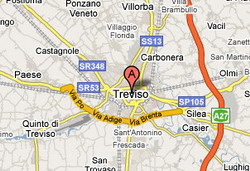
Treviso, population
about eighty thousand, has had a long and bloody history. It was close
to the site of an important battle in World War I and the site of a concentration
camp in World War II. During that war the medieval city was heavily damaged
with quite a loss of life. In spite of the massive destruction its center
is still something to see. Treviso is home to the famous designer Benetton
and has enough canals to merit the nickname "Little Venice".
Start your visit at the Piazza
dei Signori (Square of the Gentlemen), the center of the medieval town,
with several buildings of interest including the Twelfth Century Palazzo
dei Trecento (Town Hall). Close by you’ll find the Pescheria (Fish Market)
on an island in the canal. |
Among the churches to see
is the Late Romanesque-Early Gothic Twelfth Century Church of San Francesco
(Saint Francis), used by Napoleonic troops as a stable. It contains several
paintings and frescoes of interest and the tombs of Pietro Alighieri, son
of Dante, and Francesca Petrarca, daughter of the poet Francesco. The Church
of San Nicolò is a mixture of Thirteenth Century Venetian Romanesque
and French Gothic elements. It is also loaded with historic frescoes. The
Duomo di San Pietro (Saint Peter’s Cathedral) was built in the Fifteenth
and Sixteenth Centuries on the site of a Romanesque church. Among its artwork
is Titian’s The Annunciation.
What about food? Treviso
is known for many specialties including various pasta and rice dishes with
wild herbs and vegetables, such as risotto with wild asparagus (bruscandoi).
When gourmets think of Treviso it’s often for the local radicchio, perhaps
served in risotto. Other popular local dishes include bigoli, thick homemade
spaghetti served with duck or sausage sauce, risi e bisi (rice with peas),
and pasta e fagioli (pasta with beans). Meat and cold cuts are often served
with peverada, a strong sauce made with liver and spices. Like several
other areas, Treviso claims the famous Italian dessert, tiramisu.
| Let’s suggest a sample menu,
one of many. Start with Sopa Coada (Pigeon and Bread Soup). Then try Ravioli
ai Porcini e Ricotta Affumicata (Ravioli with Porcini Mushrooms and Smoked
Ricotta Cheese). For dessert indulge yourself with Focaccia alla Ceccobeppe
(Flat Bread with Dried Fruit). Be sure to increase your dining pleasure
by including local wines with your meal.
We’ll conclude with a quick
look at Veneto wine. Veneto ranks 3rd among the 20 Italian regions both
for the area planted in grape vines and for its total annual wine production.
About 45% of Veneto wine is red or rosé, leaving 55% for white.
The region produces 24 DOC wines and 3 DOCG wines, Recioto di Soave, Soave
Superiore, and Bardolino Superiore.
DOC stands for Denominazione
di Origine Controllata, which may be translated as Denomination of Controlled
Origin, presumably a high-quality wine. |

Buy
This Allposters.com
|
The G in DOCG stands for
Garantita, but there is in fact no guarantee that such wines are truly
superior. Almost 30% of Venetian wine carries the DOC or DOCG designation.
Montello e Colli Asolani
DOC is produced on the right bank of the Piave River north of Treviso.
There are many styles made from a variety of local and international grapes.
The best known is Prosecco, made from the white Prosecco grape with up
to 15% of other white grapes, mostly local, but including Chardonnay. While
Prosecco wine may be still or fizzy, it is usually sparkling. And it is
usually not very special.
top
/ Treviso
Featured Hotels / Vicenza
Hotels
By Levi
Reiss |
TREVISO
FEATURED HOTELS - THE VENETO, ITALY
|
|
Search
for hotels in Treviso, The Veneto, Italy
 |
Best
Western Hotel Al Fogher Treviso
Best Western Hotel Al Fogher
is located in Treviso, close to Church of San Nicolo, Cathedral of Treviso,
and Palazzo dei Trecento. Nearby points of interest also include Piazza
dei Signori and Piazza Rinaldi. Rooms and business services. A complimentary
continental breakfast is served daily. Additional property amenities include
a bar/lounge, valet parking, and secure parking. There are 55 guestrooms
at Best Western Hotel Al Fogher. Coffee/tea makers and minibars are offered.
Bathrooms feature hair dryers. Guestrooms offer phones and in-room safes.
Televisions have cable channels. |
 |
B4
Treviso Maggior Consiglio by Boscolo Treviso
Located in Treviso, B4 Treviso
Maggior Consiglio by Boscolo is connected to the airport and close to Church
of San Nicolo, Loggia dei Cavalieri, and Palazzo dei Trecento. Additional
points of interest include Piazza dei Signori and Cathedral of Treviso.
Dining options at B4 Treviso Maggior Consiglio by Boscolo include 2 restaurants
and a bar/lounge. Room service is available during limited hours. A complimentary
breakfast is served daily. Recreational amenities include 2 spa tubs. Also
located on site are an indoor pool, a health club, a fitness facility,
and a sauna. Spa amenities include spa services, massage/treatment rooms,
facials, and body treatments. Additional property amenities include
a coffee shop/café, multilingual staff, and laundry facilities. |
 |
BHR
Treviso Hotel Treviso
Situated near the airport,
this Quinto di Treviso hotel is also close to Church of San Nicolo. Another
nearby attraction is Cathedral of Treviso. Dining options at BHR Treviso
Hotel include a restaurant and a bar/lounge. Room service is available
during limited hours. A complimentary breakfast is served daily. Recreational
amenities include a spa tub, a sauna, a fitness facility, and a steam room.
Spa amenities include spa services and beauty services. Guest parking is
available for a surcharge. Additional property amenities include a library,
a coffee shop/café, and a concierge desk. |
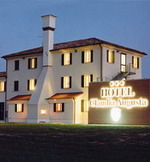 |
Hotel
Claudia Augusta, Casale sur Sile, Treviso
The Hotel is located inside
the River Sile Nature Park just a few kilometres from Treviso and Venice.
The name of the Hotel is taken from its very siting, in the immediate vicinity
of the Claudian Augustean way which was named after Roman Emperor Claudius
(41-54 AD). According to epigraphic sources (two milestones unearthed in
Rablà and Cesiomaggiore), Claudius had this important arterial road
built in 46 AD following a layout originally designed by his father Druso
at the time of his military offensives against Norico (present-day Austria)
in 16-13 BC. The hotel has 32 rooms, all very spacious, which have
been designed with both couples and families with children in mind. |
 |
Hotel
Villa Odino near Treviso
This hotel is located in
Quarto d Altino. Recreational amenities include a private beach. This 4.0-star
property has a business center and offers small meeting rooms, secretarial
services, and limo/town car service. High-speed Internet access is available
in public areas. Room service is available 24 hours a day. A complimentary
buffet breakfast is served daily. The property offers an airport shuttle
(surcharge). Guest parking is complimentary. Additional property amenities
include a library, a bar/lounge, and a coffee shop/café. |
Continue
browsing hotels in Treviso and surrounding areas, The Veneto, Italy
Top
|