|
Search
this site

View
map of Europe
View
map of Italy
|
 |
 This
article examines tourist attractions in the Shakespearean town of Verona,
a UNESCO World Heritage Site. Be sure to read our companion articles on
northern
Veneto, southern
Veneto, and the university city of Padua. This
article examines tourist attractions in the Shakespearean town of Verona,
a UNESCO World Heritage Site. Be sure to read our companion articles on
northern
Veneto, southern
Veneto, and the university city of Padua.
Verona. I don't know
about you, but I can't hear this word without thinking of the phrase, Two
Gentlemen of Verona, a not particularly well-known Shakespeare play. Verona
was the setting of a particularly well-known Shakespeare play, Romeo and
Juliet. This city of more than a quarter million has a long and bloody
history. Its residents are proud that on an Easter Monday more than two
hundred years ago they drove out the French occupiers. The German writer
Goethe and the French writers Stendhal and Valery included Verona in their
travel diaries. The Roman emperor Julius Caesar spent a lot of time here,
and probably enjoyed many of the sights described next.
| Verona has quite a collection
of vestiges from its Roman days. Let's start with its Roman amphitheatre,
the third largest in Italy. This structure is approximately 400 feet (140
meters) long and 350 feet (110 meters) wide, giving it a seating capacity
of about 25,000 spectators in 44 tiers of marble seats. While only fragments
of the outer walls remain, its interior is virtually intact. This edifice
often hosts fairs, theatre, opera and other public events, especially during
the summer.
A First Century B.C. Roman
theatre was subsequently transformed into a housing site. In the Eighteenth
Century the houses were demolished and the site restored. Nearby you'll
find the Ponte di Pietra (Stone Bridge), a Roman arch bridge crossing the
Adige River, completed in 100 B.C. Retreating German troops destroyed four
of the bridge arches in World War II but the bridge was rebuilt in 1957
using original materials.
You should also see the First
Century Arco dei Gavi (Gavi Arch) straddling the Corso Cavour; once the
main road into the city. Look for the architect's signature, a rarity for
the times. French troops destroyed this arch in 1805, and it was rebuilt
only in 1932. |

Buy
This Allposters.com
|
Porta
Borsari, an archway at the end of the Corso Porta Borsari street, is the
façade of a Third Century gate within the original Roman city walls.
This street is lined with several Renaissance Palaces. Porta Leoni (Leoni
Gate) is all that remains of a First Century B.C. Roman city gate. Parts
of it have been incorporated into a wall of a medieval building. Even in
those days some people believed in recycling. You can see the remains of
the original Roman street and the gateway foundations if you look slightly
below the present street level.
The Twelfth Century Romanesque
Duomo (Cathedral) was constructed on the site of two Palaeo-Christian churches
destroyed by an earthquake much earlier in the century. The site includes
an unfinished Sixteenth Century bell tower. Be sure to see the chapel adorned
with Titian's Assumption.
Verona's largest church is
the Fifteenth Century Sant'Anastasia whose interior is considered one of
northern Italy's finest examples of Gothic architecture, and believe me
this competition includes many entries. The construction of this magnificent
edifice took nearly two hundred years. Among its items of honor are frescoes
and hunchback statues that serve to dispense holy water. It is said that
touching a hunchback's hump brings good luck. Maybe next time.

Buy
This Allposters.com
|
San Fermo Maggiore is in
reality two churches. The tomblike lower Romanesque church dates from the
Eighth Century. The huge Fourteenth Century Gothic upper church is notable
for its ceiling festooned with the paintings of four hundred saints. There
are more churches to see in Verona but we are now going to look at castles
and palaces.
The Fourteenth Century Castelvecchio
(Old Castle) was built on the banks of the Adige River near the Ponte Scaligero
(Scaligero Bridge), probably on the site of a Roman fortress. Built to
protect against foreign invaders and popular rebellions, it included a
fortified bridge in case the owners had to flee north to join their allies
in the Tyrol. Over the centuries the castle has undergone many renovations
and restorations. Make sure to visit its art museum, specializing in Venetian
painters and sculptors.
Those Scaligeris spent a
lot of their time in the Palazzo degli Scaligeri, their medieval palace,
which today, as then, is closed to the general public. But you can go next
door to the Arche Scaligere with its Gothic tombs of selected members of
the family. |
The
Italian Piazza is a meeting place. Verona has some special examples. The
Piazza delle Erbe (Herb Square) has been around since the days of the Romans.
For ages it was a fruit and vegetable market but now is geared to tourists.
It still maintains its medieval look and some of the produce stalls. The
Piazza dei Signori (Gentlemen's Square) is Verona's center of activities
as it has been for centuries. This square is right next door to the Scaglieri
Palace. Those gentlemen didn't believe in commuting.
We can't leave Verona without
visiting those star-crossed lovers, Romeo and Juliet. The Twelfth Century
Casi di Giulietta (Juliet's House) long belonged to the Dal Cappello family
and since it's not a long way from Cappello to Capulet perhaps... This
lovely house even possesses a courtyard balcony. Yes, the house at Via
Cappello, 23 probably isn't the real thing, but crowds come to gawk and
dream. This could be the place to propose marriage.
What about food? Verona's
cuisine features typical dishes of the Po Valley plains: mixed boiled meats,
nervetti (calf's foot and veal shank salad), and risotto, often prepared
with a healthy douse of Amarone wine. The Piazza delle Erbe still hosts
some fruit and vegetable stalls that sell local produce such as radicchio
and asparagus. Not only the wine is classified. Verona boasts a classified
cheese, Monte Veronese. But who would think that rice is also classified?
The Riso Nano Vialone Veronese is a laboratory-developed rice first introduced
into the area in 1945. It now represents 90% of the local production. Is
it better than other rice? Locals obviously think so. I promise that I
will taste it on my next trip to Verona.
Let's suggest a sample menu,
one of many. Start with Gnocchi (Small Potato Dumplings). Then try Pastissada
de Caval (Horsemeat Stew, often simmered in wine).
| For dessert indulge yourself
with Pandoro di Verona (Verona Butter Cream Cake). Be sure to increase
your dining pleasure by including local wines with your meal.
We'll conclude with a quick
look at Veneto wine. Veneto ranks 3rd among the 20 Italian regions for
the area planted in grape vines and for its total annual wine production.
About 45% of Veneto wine is red or rose, leaving 55% for white. The region
produces 24 DOC wines and 3 DOCG wines, Recioto di Soave, Soave Superiore,
and Bardolino Superiore. DOC stands for Denominazione di Origine Controllata,
which may be translated as Denomination of Controlled Origin, presumably
a high-quality wine The G in DOCG stands for Garantita, but there is in
fact no guarantee that such wines are truly superior. Almost 30% of Venetian
wine carries the DOC or DOCG designation. |

Buy
This Allposters.com
|
Valpolicella DOC is a world
famous wine produced north of Verona from several local red grapes. This
wine is usually nothing to write home about and often tastes of cooked
cherries. But that is hardly the end of the Valpolicella story. Valpolicella
Ripasso is made from young Valpolicella wine put into tanks or barrels
containing the lees (one could say dregs, but that might give the wrong
impression) of a recioto wine (see below). The mixture undergoes a secondary
fermentation and becomes a more interesting wine. Valpolicella Recioto
is made from passito grapes, those dried on mats for several months. It
may be a still wine, a fizzy wine, or a sparkling wine. Valpolicella Recioto
is sweet or bittersweet. Amarone DOC is a type of Valpolicella Recioto
whose sugar has been completely transformed into alcohol becoming a powerful
tasting wine that packs a punch and ages well. What a difference between
Amarone and its source wine, Valipolcella.
top
/ Verona
Featured Hotels
About the Author - Levi Reiss
has authored or co-authored ten books on computers and the Internet, but
he prefers drinking fine Italian or other wine, accompanied by the right
foods and people. He knows about dieting but now eats and drinks what he
wants, in moderation. He teaches classes in computers at an Ontario French-language
community college. His new wine, diet, health, and nutrition website http://www.wineinyourdiet.com
links to his other sites. |
VERONA
FEATURED HOTELS - THE VENETO, ITALY
|
|
Search
for hotels in Verona, The Veneto, Italy
 |
B4
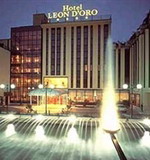
Verona Leon d'Oro by Boscolo Verona
Leon d'Oro Hotel is your
touchstone for discovering centuries of history and art, world-class theatrical
productions and an exquisite gastronomic experience. The Leon d'Oro
Boscolo Hotel Verona is a beautiful hotel situated in the heart of Verona.
The Leon d'Oro Hotel offers its guests a selection of 206 generous rooms,
all in the same rich and elegant style that characterises the entire hotel.
Be sure to dine at the Salgari Restaurant that offers the traditional local
cuisine or visit the Le Opere American Bar for a cocktail or a sampling
of fine pastries. Guests on business can utilise the meeting facilities
that offer the highest standards of comfort, design and technology. The
region has a lot to offer for your free time. |
 |
Cristallo
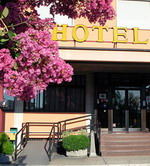
Hotel Verona
Offering comfortable accommodation
and convenient facilities, the Cristallo Hotel Verona provides you with
all of the quality amenities to make your stay a memorable one. The
Cristallo Hotel is located in the southern part of Verona, just 8 kilometres
from the historical centre. In addition, the hotel is placed close to the
exhibition centre and the motorway. The hotel boasts 91 rooms, which
offer a high-standard of hospitality and different room types to satisfy
all your requests, either for business, leisure or groups. The onsite
restaurant offers an intense pleasure starting from the breakfast, and
at dinner there is always a vegetable buffet together with the a la carte
menu with typical and local cuisine. |
 |
Maxim
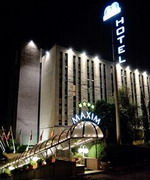
Hotel Verona
Characterised by exceptional
quality, modern style and maximum of care for its guests, this property
with its strategic position is a good solution for both business or pleasure
travellers. Boasting a privileged location in Verona, the Maxim Hotel
is just a kilometre from the Porta Vescovo, while the Verona and Vicenza
Exhibition centres and many other famous attractions are just few kilometres
away from the hotel. Being a charming oasis of tranquillity the fabulous
on-site restaurant will tantalize your taste buds with wonderful cuisine.
The beautifully decorated bar is the ideal meeting place for those who
wish to try the impressive and ever changing cocktail. |
 |
Monaco
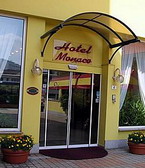
Hotel Verona
If you are planning for
an ideal holiday destination in Verona, the Monaco Hotel is a perfect place
for you to reside and explore the surrounding areas. Monaco Hotel
is located 300 metres from the exit of Verona South, at 1.5 kilometres
from the exhibition centre and 4 kilometres from the historical city centre.
The hotel has 58 comfortable rooms that are well furnished and equipped
with standard amenities. The hotel features an informal snack-bar
cafe and an excellent typical restaurant for your dining pleasure. |
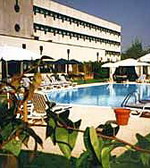 |
Saccardi
Quadrante Europa Hotel Verona
If you want to avoid the
traffic and the chaos of the city centre, without being too far from it
or want to spend your holidays near the Lake Garda, then this hotel is
the right place to be. Saccardi Quadrante Europa Hotel is located
at the intersection of the highways and is less than 10 Kilometers far
from the fair centre and the golf course. There are 120 rooms and
6 suites, all sound proof, elegantly furnished and equipped with every
comfort. The onsite restaurant provides Italian and local specialities
along with the most famous international cuisine, carefully cooked and
prepared by the Chef. For relaxation, you can visit the Well-being
Center, the hotel's Health Spa where an indoor swimming pool, sauna, steam
bath, hydromassage and a gym are available. |
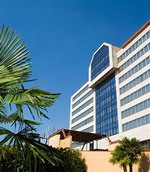 |
Tryp
Verona Hotel and Convention Center, Verona
The Tryp Verona Hotel and
Convention Center is located in the suburbs of Verona, in the industrial
area of San Giovanni Lupatoto. The hotel is well communicated with the
most important cities in northern Italy as well as with the International
Airport Valerio Catullo. Placed just 3 kilometres from the Exhibition Centre,
this hotel is 5 kilometres from the city centre of Verona. This hotel
has 196 double rooms and 7 junior suites that offer stunning views of the
Dolomiti Mountains or the Verona. Start of your day with a extensive buffet
breakfast served at the hotel. For lunch and dinner, you can dine at the
onsite a la carte restaurant that specialises in regional and Mediterranean
cuisine. You can also enjoy some snacks and cocktails served at the cafeteria. |
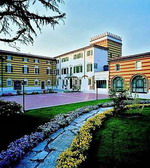 |
Villa
Malaspina Hotel Verona
Villa Malaspina Hotel welcomes
its guests in a charming and historical surrounding. This Villa, dating
from the XVI century, has been lovingly restored to its past glory and
is today a luxurious hotel combining style and history together with the
best of modern facilities. Villa Malaspina Hotel is conveniently
located in the quiet countryside just outside Verona, yet well connected
to the town by public transport. Verona Exhibition Centre is just 6.5 km
away and the town centre is 9 km away. The hotel offers accommodation
in 70 individually designed rooms and junior suites, all different in size
and colours. They are all equipped with the latest modern facilities.
The leading concept of the restaurant is simplicity. Simple traditional
flavours are preserved by simple, natural, light cooking techniques. |
Continue
browsing hotels in Verona, The Veneto, Italy
Top
|