|
Agra finds mention in the epic Mahabharata when it was
called Agrabana are Paradise. Ptolemy, the famous second century A.D.
geographer, marked it on his map of the world as Agra. Tradition and
legend ascribe the present city of Raja Badal Singh (around 1475 A.D.)
whose Fort, Badalgarh, Stood on or near the site of the present Fort.
However, the 12th century A.D. persian poet Salman writes of a desperate
assault on the fortress of Agra, then held by one King Jaipal, by Sultan
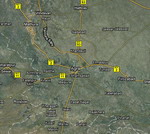
Mahmud of Ghazni. It is a city on the banks of the Yamuna River in
India. It was ruled by Sultan Sikandar Lodi in the year 1506. It lies
currently in the Indian state of Uttar Pradesh. It achieved fame as the
capital of the Mughal emperors from 1526 to 1658 and remains a major
tourist destination because of its many splendid Mughal-era buildings,
most notably the Taj Mahal, Agra Fort and Fatehpur Sikri, all three of
which are UNESCO World Heritage Sites.
Tourists
Attraction in Agra by Vinay Chaubey
Agra
is famous as being home to one of the Seven Wonders of the World-the Taj
Mahal. The architectural splendor of the mausoleums, the fort and the
palaces is a vivid remainder of the mausoleums, the fort and the palaces
is a vivid reminder of the capital in the 16th and early 17th centuries.
Taj
Mahal
|
The construction of this
marble masterpiece is credited to the Mughal emperor Shah Jahan who
erected this mausoleum in memory of his beloved wife, Arjumand Bano
Begum, popularly known as Mumtaz Mahal, who died in AH 1040 (AD 1630).
Her last wish to her husband was "to build a tomb in her memory
such as the world had never seen before".
The
designer of Taj Mahal was Ustad Ahmad Lahauri. The material was brought
in from all over India and central Asia and it took a fleet of 1000
elephants to transport it to the site. The central dome is 187 feet
high at the centre. Red sandstone was brought from Fatehpur Sikri,
Jasper from Punjab, Jade and Crystal from China, Turquoise from Tibet,
Lapis Lazuli and Sapphire from Sri Lanka, Coal and Cornelian from
Arabia and diamonds from Panna.
Fatehpur
Sikri
Fatehpur
Sikri is an epic in red sandstone. A city of yesteryear, today lost in
the mists of time. Fatehpur Sikri was built by the Mughal Emperor Akbar
during 1564 A.D.. Mughal Emperor Akbar had no heir. He visited holy men
to enlist their prayers for his son.
|

Buy at allposters.com
|
Sikandra
Fort
The
mausoleums of emperor Akbar represent his philosophy and secular outlook,
combining the best of Hindu and Muslim architectures in a superlative
region. Completed in 1613 A.D. by his son Jahangir, it is one of the well
preserved monuments. This is the last resting place of the Mughal Emperor
Akbar.
|

Buy at allposters.com
|
Agra Fort
The great Mughal Emperor
Akbar commissioned the construction of the Agra Fort in 1565 A.D.,
although additions were made till the time of his grandson Shah Jahan.
Agra Fort is located on the banks of the Yamuna near the railway
station.
Agra
is well connected by air with Khajuraho, Varanasi, and Delhi. It has
good rail and bus connections with major Indian cities. From the city,
there are taxis, tempos, auto-rickshaws, and cycle rickshaws to carry
one to the fort. Prepaid taxis and autos from the railway station are
also available. Bicycles can also be hired on hourly basis.
|
Itmad-Ud-Daulah
Itmad-ud-Daulah
is the tomb of Mirza Ghyas Beg, a persian who had obtained service in
Akbar Court. The Marvel tomb was made by Emperor Jahangir's Queen,
Noorjahan, for his father Mirza Ghyas Beg during 1622-1628 A.D. The
Craftmanship at Itmad-ud-Daulah foreshadows that of the Taj Mahal. It was
here that. "Pietra Dura"-the inlay work on marble-so
characteristic of the Taj-was first used.
Radha
Swami Samadhi
This is
the head quarter of Radhaswami religion; here the holy ashes of the
founder of the faith have been preserved. On the sprawing lawns here, is
a beautiful marvel temple with beautiful carving of fruits, flowers, leavesand
plants which have been reduced into stone true to nature, and are
distinctive speciments of the plastic arts. This is under construction
for almost 100 years.
Taj
Mahotsav
Come
February, and it's springtime. The time of the year when nature dawns all
its colorful splendor and Agra bursts into colorful celebrations. For 10
days there is sheer celebration of U.P.'s rich heritage of arts, crafts,
culture, cuisine, dance and music. Yes, it is Taj Mahotsav time again.
There are festivities all around and Agra truly puts on the colors of joy
and gets transformed into one non-stop carnival. Organised by U.P.
Tourism and held as an annual event at Shilpgram, literally next door to
the Taj Mahal, the Taj Mahotsav is indeed a fitting tribute to the
legendary skills of master craftsman and other exponents of art, music
and cuisine.
top
|