Lake
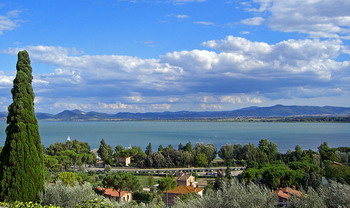
Trasimeno or Trasimene (in Italian: Lago Trasimeno), is the largest
lake in the Italian peninsula with a surface area of 128 km², slightly
less than Lake Como.
The Tiber River flows some thirty
kilometers to the east of the lake, but the lake and the river are separated
by hills: no major river flows directly into nor out of Lake Trasimeno,
and the water level fluctuates significantly according to rainfall levels
and the seasonal demands from the towns, villages and farms dotted round
the shore.
There are three islands in
the lake. The second largest, Isola Maggiore, is the only inhabited one.
The small fishing village, which reached its height in the 14th century,
today has only around thirty residents. Most of the buildings, including
the ruins of a Franciscan monastery, date from the 1300s. The largest of
these isles is Isola Polvese, almost 1 km².
Maggiore is a 'hill', while
Polvese is a more complex structure with planes and hills (Minore is a
sort of sloped table). It is now uninhabited, but in the past there was
a village with over 500 residents. Many centuries ago, there was a castle
with a pentagonal structure near the shore, and a Olivetan monastery. The
castle still remains and the ruins of the church and the monastery almost
totally preserved, despite the abandonment in the 17th century, due to
bad climate and malaria. The malaria was finally eradicated only in the
1950s. There were other problems as well, since Trasimeno was fought over
by Chiusi, Panicale, Perugia and Florence.
 Florentine
troops demolished Polvese in the 17th century, which started its decline,
until by the 19th century there was only a caretaker. Of the many houses,
nothing remains. Minore Isle, near Maggiore, is now uninhabited, totally
covered by local vegetation except a little anchorage. In ancient times,
there was a separation between the two communities, because Polvese was
far away from Maggiore-Minore. It is said that the two communities fought
against each other. But the real problems were from the regional 'powers'
that fought over this lake for centuries. Florentine
troops demolished Polvese in the 17th century, which started its decline,
until by the 19th century there was only a caretaker. Of the many houses,
nothing remains. Minore Isle, near Maggiore, is now uninhabited, totally
covered by local vegetation except a little anchorage. In ancient times,
there was a separation between the two communities, because Polvese was
far away from Maggiore-Minore. It is said that the two communities fought
against each other. But the real problems were from the regional 'powers'
that fought over this lake for centuries.
The fishing in the lake used
a particular technique called 'Tuoro' or 'pesca da tuori', a very complex
system that consisted of a wooden trap in the water and a circular structure
to hold the net around it. The nets trapped the fishes and they were brought
to the village to be dried. This system worked with a high water level,
but was abandoned when the level dropped. A mock up of this system was
built several years ago near Polvese Isle's port.
There are many castles all
around Trasimeno. Many of them are in the center of small towns while others
are isolated and in ruins. Castiglione del Lago, Passignano, Magione, Maggiore
and Polvese isles have all a castle, while Zocco Castle, Montali Castle
and others are on hilltops.
The Guglielmi Castle in Maggiore
Isle is not ancient, as it was built in the late 1800s on the foundation
of an old Franciscan church, and for many years was a well frequented place
in the Trasimeno area. Lying in ruins during the last decades, until 1998
it was still visitable, then it was closed because the structure became
dangerous. Now it is being restored by a new proprietor, but the work is
far from completed.
Between Monte del Lago and
S.Feliciano there is the old Zocco castle, ruined for decades. It is privately
owned, but sadly nobody tends to its maintenance. This is one of the biggest
castles of the area and the only one that, inside its sandstone walls,
has a still untouched medieval keep. Some years ago it was probably inhabited,
as there is a building fitted with an TV antenna, but now its only entry
is closed.
The best preserved part is
the eastern and the southern walls (here illustrated) one, while the rest
of the walls are mostly demolished or fallen down. One of the southern
towers has two enormous cracks with the middle.
The Vernazzano leaning tower
(around 20 m in height) perhaps leans even more than the famous leaning
tower of Pisa. This unique remnant of an ancient castle was built before
1089, when the whole castle was donated by Marchiones family to the monastery
of Città di Castello. In 1202 began under control of Perugia and
so this city gained the control of Northern Trasimeno. It was built on
M.te Castiglione, near two torrents. The castle and the surrounding settlement
at Vernazzano, were damaged by wars in 1400s and two century later, by
a strong earthquake (followed by damaging after-shocks). Erosion of the
foundations by torrents caused the tower to lean in the eighteenth century.
Vernazzano was rebuilt in the valley, away from this site which had been
effective for territorial control, but was less well suited for living
in. The Leaning Tower has therefore been abandoned for almost 300 years.
To avoid its collapse, a steel reinforcement was recently added, with plates
and wires even thicker than 2-3 cm. The Tower is not well known, being
located away from the main streets. (It is visible from far away, but not
easily accessible). So it can continue to exist approximately 1000 years
after its original construction
top
/ Lake
Trasimeno Area Featured Self-Catering
read
more |