|
But
don't forget its culture, its food and its people that make Rome a modern,
vibrant city which is bustling and lively with excellent restaurants and
exceptional nightlife making Rome an appealing destination for those with
a phobia of history.
Rome is full
of history everywhere you look. It has many ancient monuments, interesting
medieval churches, beautiful fountains, museums, and Renaissance palaces,
most visibly the Colosseum, and the Forum and Palatine Hill; but from here
there's sequence of monuments - from early Christian basilicas and Romanesque
churches to Renaissance palaces and the fountains and churches of the Baroque
period.
No city in the
world is as beautiful as Rome, and few as glamorous….
Arrival
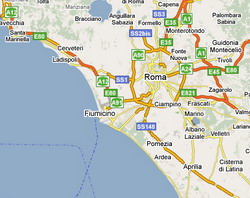
Rome is located
approximately in the middle of the Italian peninsula and therefore is easily
reached either from the north or from the south of the country. The capital
is well connected to the rest of Italy and the world, thanks to the two
airports and the excellent highway and train systems.
By plane:
Fiumicino "Leonardo da Vinci" (FCO) Officially named Leonardo da Vinci
Airport, Fiumicino is a major port of call for intercontinental as well
as national and European flights. The airport is situated 32km from the
city, close to the sea.
The airport is
very well connected to Roma Termini station by the Leonardo Express train,
with departures every 30 minutes or by metro FM1, with some stops, to Roma
Tiburtina. Between 11.30pm and 5am there is a Cotral night bus linking
Fiumicino to Stazione Termini and Stazione Tiburtina. A shuttle bus connects
the parking with arrivals and departures from terminal A, B and C.
Ciampino Airport
(CIA)
Ciampino is the
second airport of Rome and is mainly used by low-cost airlines. To get
to the city you must first take a Cotral bus (every half hour) and then
subway A from Anagnina station. Also available is the Terravision Shuttle
in conjunction with Ryanair and Easy-Jet flights.
By
train: The capital's main station is Roma Termini: from here depart
the majority of fast long distance trains (Eurostar, Intercity, Espressi)
to all points in Italy. From Termini buses take off for all destinations
and there is a subway stop also. Some trains, especially night ones, come
and go from Roma Tiburtina. It is the second train station in Rome and
is reachable from Termini by bus and by metro. For times please consult
the Trenitalia site or call the green number 89 20 21.
By car:
Rome is circumscribed in its entirety by a ring road (Raccordo Anulare)
where highways coming from all parts of Italy meet. Those coming from Naples
and from the South generally must travel the whole length of highway A1.
For those coming from the North of Italy, from Tuscany or Umbria, follow
A1 "Autostrada del Sole" up to the capital. From Genoa, Pisa and from the
Tyrrhenian coast take A12 up to Rosignano and continue on Superstrada S1
"Aurelia" up to Rome. From Pescara and from the Adriatic coast you must
take A24/A25 up to destination.
History and
Culture
Ancient Romans
believed their city had been founded on 21 April 753 BC, and more recent
archaeological discoveries pretty much back this up. According to myth,
the city was founded by the twin sons of Mars, god of war, and Rhea Silvia,
princess and (until meeting Mars) vestal virgin. The twins, Romulus and
Remus, were abandoned on the shores of the Tiber and brought up by a she-wolf.
The story goes that the first city center sprang up in 753 B.C. on the
Palatine hill, built by Romulus after he had killed his twin brother Remus.Romulus
was the first of the seven kings of Rome, who started off the basic characteristics
of this city that would go on to make Rome powerful throughout the ancient
world.
The non-mythical
city was ruled by Etruscan kings until 510 BC, when it became a republic.
By the 2nd century BC the city controlled central and southern Italy, had
defeated the rival empire of Carthage and was poised to take over the whole
Mediterranean. But as Rome became more powerful abroad, its citizens got
more uppity at home - the city suffered several civil wars, with the last
wrapping up on the Ides of March, 44 BC, when Brutus backstabbed Julius
Caesar.
The
Emperor Octavius Augustus brought Rome to its “golden era”: a lengthy period
of peace and stability, which was celebrated with monumental works of art.
Many emperors came after him, each of whom was famous for some work, conquest
or edict. Under Traianus, the empire enjoyed its period of maximum expansion
and reached as far as ruling land that stretched from the Danube to the
Nile.
With the rise
of Christianity in the 4th century, Rome lost much of its secular power
but became the centre of a new empire, Christendom. The Bishop of Rome
was named successor to Saint Peter (or, in other words, Pope). Many of
the city's large basilicas - such as Santa Croce, Santa Maria Maggiore,
San Pietro and San Sebastiano - were built around this time.
The Church's
power continued to increase and Rome became the representation of this
power on earth. Between 1300 and 1600, many churches were built, beautifully
painted with frescoes by Renaissance artists such as Raffaello and Michelangelo.
Crowds of pilgrims flocked to the Eternal City from all over the world
to admire its Baroque squares, its fountains and its monumental basilicas.
In 410, the Barbarian
invasions began, but in truth the citizens themselves did more damage,
stripping many of the city's fine buildings for their marble. The Western
Roman Empire bit the dust in 476 when Odoacer deposed Emperor Romulus Augustulus
- from this time on power moved east, and Germanic and Byzantine empires
bickered over authority over Rome. In the late 8th century, Pope Stephen
II backed up the claims of Frankish king Pepin the Short that he was the
chosen of God, and in return received a parcel of land around Rome. The
alliance became known as the Holy Roman Empire - combining the power of
church and state.
Modern History:
After the patriotic
unrest that started in 1848 and which was headed by Garibaldi, a plebiscite
approved the annexing of Rome to the Kingdom of Italy in 1870, which set
up its official center in the city soon after.
Starting from
1920, Rome , During Mussolini's rule, Rome took on Fascist airs, puffing
out its chest with wide boulevards and overblown architecture, Dreams of
imperial glory led Mussolini to form an alliance with Germany during WWII,
after Italy was liberated by the Allies during the Second World War, a
referendum held on June 2nd 1946 sanctioned the end of the monarchy and
the beginning of the Republic.
City Transport
Rome has an extensive
bus and metro system (Metripolitana) so you can easily get almost anywhere
on public transportation. Be aware of pickpockets when riding in crowded
subway cars. There is a good transportation map, Roma that's worth buying
if you plan to use public transportation. Look for it in tourist offices,
newspaper stands, or souvenir shops.
Buses run from
around 06:00 to 24:00, with some services running throughout the night.
The city's Metro service (which is convenient for many of Rome's sights)
has two lines, A (red) and B (blue), both of which go through Termini..
Unfortunately, The metro automatic ticket machines only take exact change
so it is recommended that you buy your ticket from a tobacconist, newsstand
or vending machine before you get on the train or bus (your bus tickets
will also work on the metro). For the metro, validate your ticket before
boarding the train; for the bus, look for the validation machines onboard.
Use the orange validation machines for the old paper tickets and the yellow
ones for the newer magnetic tickets. If you are caught without a validated
ticket, the fine is 51.65 Euro. The metro runs about every 7-10 minutes,
from 5:30am until 11:30pm everyday, except Saturday when it runs until
12:30am.
Churches
and Museums
St. Peter's
Basilica - A huge sanctuary of Christian religion. Its façade
is 45 meters high, and its enormous dome is 136 meters. St. Peter's Basilica,
the largest church in the world, overlooks the square that carries the
same name that was designed by Bernini and which is surrounded by a colonnade.
Grandeur and majesty: this is the sensation that one gets walking up Via
della Conciliazione towards Piazza San Pietro. One of the most important
works of art inside is the “Pietà” sculpture by Michelangelo, that
was created between 1498 and 1500.
The Church
of Sant'Ignazio - In the centro storico, the church of Sant'Ignazio
has a marvelous and often overlooked trompe l'oeil false cupola, covered
in figures in various states of action and repose.
The Sistine
Chapel - This chapel owes its name to Sixtus IV, the Pope who commissioned
the building of the chapel at the end of the 14th century. The Chapel was
decorated by famous 15th century painters such as Botticelli and il Ghirlandaio.
Later, in the 16th century, Michelangelo was called upon to paint all the
frescoes on the chapel's vaulted ceiling: about 1000 square meters. He
painted frescoes representing stories from the Bible such as the amazing
Universal Judgment, which caused a scandal because of the nudity of about
four hundred people in it, and the Creation of Mankind.
Basilica of
St. John Lateran - This is the Cathedral of Rome, the most important
church after St. Peter's. Founded by Constantine in the 4th century, San
Giovanni was the first Christian basilica constructed in Rome. It is still
Rome's cathedral and the pope's seat as Bishop of Rome. Destroyed by fire
twice and rebuilt several times, the combination of styles adds up to one
hugely impressive church. The first church was built in 314, when the Emperor
Constantine gave the land to the Pope. The current building complex is
made up of the Church, the Baptistery, Palazzo Lateranense, the Scala Santa
and the Hospital of San Giovanni.
The Church
of Immaculate Conception - A must for fans of the macabre, the Church
of Immaculate Conception has the bones of some 4000 Capuchin monks set
out in patterns on the walls or simply left as skeletons and wrapped in
their original gowns.
San
Paolo fuori le mura - This church is in Via Ostiense and was founded
in 330. It was only finished, however, in the 5th century. The Church was
built on the wishes of Constantine, who wished to commemorate the Deacon
Lorenzo, who became a martyr together with Pope Sixtus II in the middle
of the 3rd century, with a magnificent tomb.
Santa Maria
Maggiore - This church stands on the Esquilino hill and is the first
Roman church to be named after the Holy Virgin. Its bell tower is the highest
in Rome. There is a story that this was the site where fragments of wood
from Jesus' crib were kept. For this reason, the church was called Santa
Maria ad Praesepe for a certain period of time.
Rome Musuems
you should check out: The Vatican Museums - This group of museums is
divided into several sections such as the Egyptian Museum, the Ethnological
Museum, the Painting Gallery and the Raffaello Rooms to name a few. As
well as the ancient artifacts, the Vatican Museums contain hundreds of
works of art commissioned and collected by the Popes over the centuries
and created by the most famous artists in history. The statue of Laocoonte
in the courtyard of Palazzo del Belvedere is not to be missed.
The Capitoline
Museums - The Capitoline Museums are home to some of the most renowned
and beautiful statues the world has ever known founded in 1471, it houses
findings and works of art that tell the full history of Rome, from the
antique sculptures and bas-reliefs portraying the acts of the emperors
to the paintings on show in the Picture Gallery.
Galleria Borghese
-
Galleria Borghese is Rome's finest art gallery; a museum displaying some
of the world's greatest works of art in an exquisite setting. was formed
by Cardinal Scipione Borghese, the most passionate and knowledgeable art
collector of his day. The collection - including works by Caravaggio, Bernini,
Botticelli and Raphael - and the mansion were acquired by the Italian state
in 1902; a lengthy restoration took place in the 1990s
Rome
Featured Self-Catering / Rome
Hotels / Lazio/Roman
Countryside & Lakes Self-Catering
About the Author: Giuseppe
Longo |